Almost every growing business eventually hits the same fork in the road: keep adapting an off-the-shelf software tool that’s “close enough,” or invest in a custom application built specifically around how the business actually operates. Neither choice is universally right — the correct answer depends on how unique your workflow really is, how much off-the-shelf software is costing you in workarounds, and what your growth plans look like over the next few years. This guide walks through the real trade-offs so you can make that call with clear eyes.
Why This Decision Trips Up So Many Businesses
Off-the-shelf software is faster and cheaper to start with, which makes it the obvious early choice — but “obvious early choice” and “right long-term choice” aren’t always the same thing. Many businesses only revisit this decision after years of stacking workarounds, spreadsheets, and manual processes on top of a tool that was never quite built for how they operate.
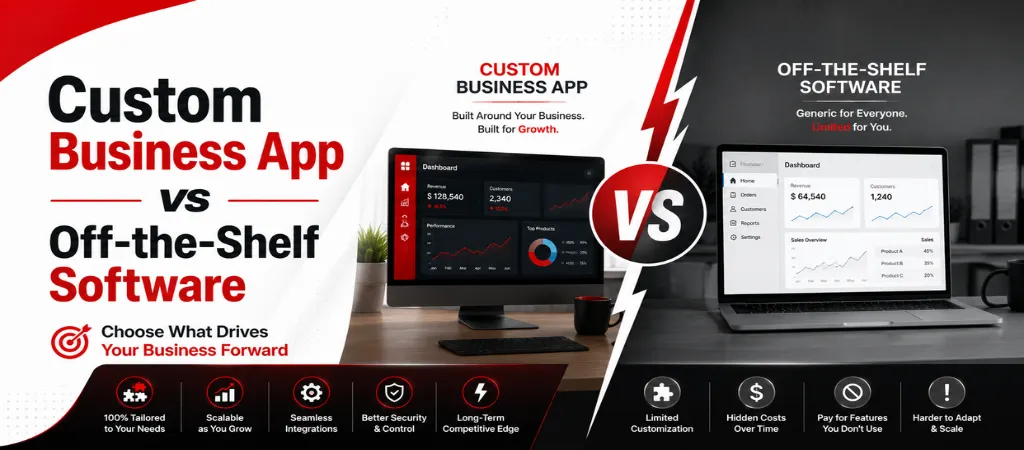
Quick Comparison: Custom vs Off-the-Shelf
Factor
Off-the-Shelf Software
Custom Business App
Upfront cost
Lower
Higher
Time to launch
Days to weeks
Weeks to months
Fit to your exact workflow
Approximate
Exact
Ongoing licensing fees
Yes, recurring per-user
None (aside from hosting/maintenance)
Flexibility to change later
Limited by vendor’s roadmap
Fully controlled by your business
Ownership
You rent access
You own the software
When Off-the-Shelf Software Is the Right Call
Off-the-shelf software makes sense when your workflow is fairly standard — accounting, basic CRM, email marketing, project management for common use cases — and when speed to launch matters more than a perfect fit. It’s also the more sensible choice for very early-stage businesses that are still validating their processes and don’t yet know exactly what a “perfect” system would look like.
When Custom Software Actually Pays Off
Custom development tends to make financial and operational sense when:
Your business has a genuinely unique workflow that off-the-shelf tools consistently force you to work around
You’re paying for multiple disconnected tools (and staff time) to patch together something an off-the-shelf platform can’t do natively
Client-facing functionality (booking, portals, tracking) is a competitive differentiator, not just an internal convenience
Your team size and per-user licensing costs on an off-the-shelf platform are growing fast enough that a one-time custom build could pay for itself within a reasonable timeframe
Data ownership, security requirements, or compliance obligations require more control than a third-party platform allows
The Real Cost Comparison Over Time
Off-the-shelf software’s lower upfront cost is real, but it’s recurring — per-user licensing fees compound every month, every year, and typically increase at renewal. Custom software has a higher upfront investment but no ongoing per-user licensing fee, only hosting and maintenance costs. For a growing team, the crossover point where custom development becomes cheaper than continued licensing fees often arrives sooner than business owners expect — particularly once headcount or usage scales.
Hidden Costs of "Making Do" With the Wrong Off-the-Shelf Tool
The cost of an ill-fitting off-the-shelf tool rarely shows up as a single line item — it shows up as staff time spent on manual workarounds, duplicate data entry across disconnected systems, and processes that don’t scale cleanly as the business grows. These costs are real but easy to underestimate because they’re distributed across many small inefficiencies rather than one obvious invoice.
Questions to Ask Before Committing Either Way
Is our current workflow genuinely unique, or are we just used to doing it a certain way?
How much are we currently paying in combined licensing fees across the tools we’re stitching together?
What would it cost, in staff time, to keep manually bridging the gaps in an off-the-shelf tool for another two to three years?
If we build custom, who owns the code and can we take it to another development partner later if needed?
What’s the realistic timeline and maintenance plan for a custom build — not just the launch cost?
How Ovron Inc Approaches This Decision With Clients
Ovron Inc doesn’t default to recommending custom development just because it’s a service we offer. We walk through a business’s actual workflow, current software costs, and growth plans before recommending whether a custom application, an off-the-shelf tool, or a hybrid approach (custom integrations layered onto existing software) is the better long-term fit.
Custom software has a higher upfront cost, but it doesn’t carry the recurring per-user licensing fees of off-the-shelf platforms. Over several years and growing headcount, custom development can end up being the more cost-effective option.
Timelines vary by complexity, but most small-to-mid-sized custom business applications take roughly 5 to 12 weeks from planning to launch, depending on the number of features and integrations required.
Yes, though it requires planning around data migration and staff retraining. Many businesses run both in parallel briefly during the transition to avoid disrupting daily operations.
A hybrid approach uses an existing off-the-shelf platform for standard functions (accounting, email) while adding custom integrations or a custom app for the specific workflows the off-the-shelf tool doesn’t handle well.
Conclusion
There’s no universal right answer between custom and off-the-shelf software — the right choice depends on how unique your workflow really is and how the long-term cost of licensing fees compares to a one-time development investment. The businesses that make this decision well are the ones that actually run the comparison, rather than defaulting to whichever option feels easier today.
Not sure which path fits your business?Talk to an Expertat Ovron Inc for an honest assessment of custom vs off-the-shelf software for your workflow.