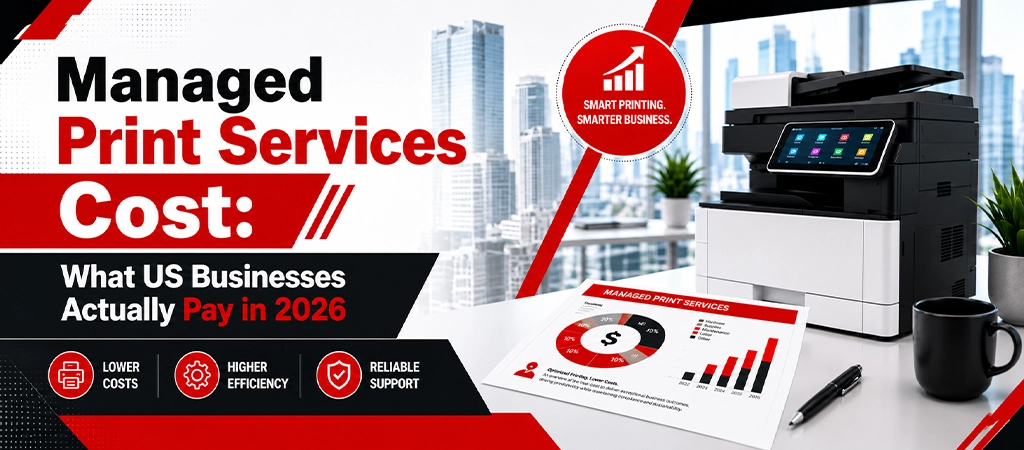
Managed print services (MPS) is a contract that includes a recurring monthly fee ($0.01–$0.03 per page for black and white, $0.05–$0.12 per page for color, or a flat fee of about $20–$60 per device per month, depending on volume and support).
Most small businesses print the same way that they use all of their other office supplies — until the ink runs out or the printer breaks down. This is a costly habit. For years, industry studies have shown that uncontrolled, unmanaged printing quietly eats between one and three percent of a company’s overall revenue, not to mention printer downtime, IT support time or printer replacements occurring earlier than they should.
Managed print services are designed to bring that cost into the daylight and onto a regular invoice, and to cut down on the number of times anyone has to think about printers. Here’s what it contains, what it costs and how to determine if it’s the right fit for your business size.
What Is Managed Print Services, Exactly?
Managed print services (MPS) are contracts in which a service provider assumes responsibility for a portion or the entirety of a business’s print environment: hardware, supplies, maintenance and reporting. Rather than reacting to the purchase of toner cartridges and calling a repair service when the cartridge fails, the business pays a set monthly fee, and the service provider takes care of the rest – proactively – before the problem causes disruptions to the workday.
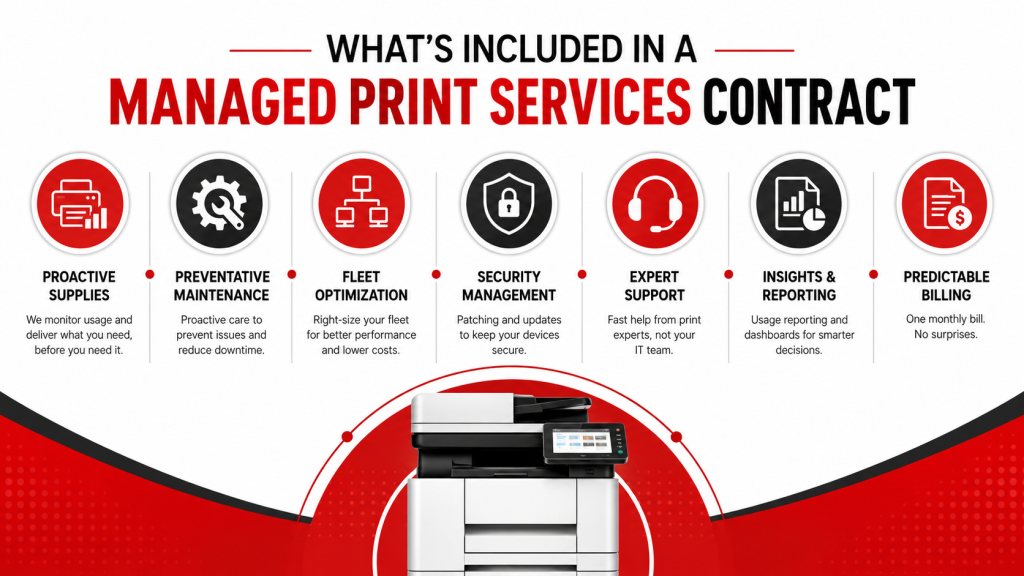
What's Actually Included in a Managed Print Services Contract
- Proactive consumable usage monitoring – the provider remotely monitors toner and page levels and delivers replacement parts before users go into a panic mode.
- Scheduled preventative maintenance — proactive cleaning and inspection that helps identify and prevent roller wear, print head failures and firmware problems before they cause downtime.
- Fleet right-sizing — assessing and determining the number of devices you actually require and where these should be located and this can sometimes result in the removal of underutilised printers and the consolidation to fewer devices that are better utilised.
- Networked devices, such as printers, are endpoints, and unpatched network components can be a huge attack surface; security patching is usually a part of the contract for MPS providers.
- Help desk support — a direct line for print-related problems, avoiding having to pass all print problems on to your internal IT team.
- Usage reporting and dashboards — the ability to see the department, device, or user that is consuming the most cost; something that most businesses have never seen before.
- Predictable, consolidated billing — one bill per month rather than toner purchases, repair bills and replacement costs dropping out of the sky.
How Much Does Managed Print Services Cost?
| Pricing Model | Typical Range | Best Fit |
|---|---|---|
| Cost per page — black & white | $0.01 – $0.03 / page | High-volume offices with predictable monthly page counts |
| Cost per page — color | $0.05 – $0.12 / page | Offices that print marketing materials, color reports, or graphics |
| Flat fee per device, per month | $20 – $60 / device | Smaller offices that prefer predictable billing over per-page tracking |
| Fleet assessment / onboarding | Often free or low-cost | One-time audit before a contract starts |
Where you land in these ranges depends mainly on print volume, the number of color devices in the fleet, and whether the contract includes full hardware coverage or consumables only. Always ask for a sample invoice from an existing customer at a similar size before signing.
How Much Can a Small Business Actually Save With MPS?
Imagine there’s a 25-person office with six unmanaged printers—some of them purchased on sale and some of them are two older laser printers that were left behind at an old office. Toner is purchased as a non-planned item and is frequently purchased at retail price. Two of the units fail annually and are replaced instead of being repaired because there are no repair relationships. It’s as if businesses in this situation are paying more for every page than they would if they had a single line item for all their toner and emergency replacements, but they aren’t realizing it.
These savings are often realized in three areas: cost savings on consumables that are purchased in bulk at a flat price rather than retail; reduced need for replacement parts due to preventive maintenance; and eliminating the need for printers that are not being used.
If you’re comparing providers, don’t focus only on the monthly fee. Review what’s included, response times, preventive maintenance, security updates, and supply management. For a closer look at pricing, see our guide on Managed Print Services Cost: What US Businesses Actually Pay in 2026.
MPS is most economical when a business has 5 or more networked devices, multiple office locations or operates in a regulated environment (healthcare, legal, financial services) where print security and auditing is important. A single office, single printer system typically does not require a complete MPS (Printer Maintenance Plan), it is more likely to fit the bill for a printer maintenance plan. Beyond that, the administrative savings of a fleet justifies the monthly expense.
Frequently Asked Questions
MPS typically involves proactive consumables management, preventive maintenance, fleet monitoring and right-sizing, security patching, help desk and consolidated reporting and billing.
Typically, costs per page ($0.01-$0.03 per page for black and white, $0.05-$0.12 per page for color) or a flat $20-$60 per device per month (depending on volume and level of coverage).
No. MPS is small enough for small offices, as few as 5 networked devices. Otherwise, companies with one or two printers are generally better off with a stand-alone printer maintenance contract.
A maintenance contract includes inspection, repair priority and parts for your existing printers. Managed print services is more comprehensive, covering everything from maintenance to consumables management, fleet strategy, security, and reporting throughout the print environment.
Most MPS contracts have a provision or two for firmware patching and network monitoring for networked printers because unpatched printers are a known target for network attacks. Make sure that this is actually stated, as it is not offered by all providers.
Conclusion
Business owners don’t often allocate their budgets for printing, and that is why it can often be costly. Managed print services allows for an expense that can vary from day to day and from location to location to be consolidated into a single monthly expense – and most of the time, it pays for itself with fewer emergency print services repairs and better consumables pricing. Ovron Inc. provides managed print services and printer maintenance plans for small and mid-sized businesses in the United States, plus a free fleet assessment to reveal the facts before you sign on the dotted line.
Table of Contents