Hybrid cloud configurations can seem like something only big companies with large IT departments can take advantage of. But a company doesn’t have to have thousands of employees to take advantage of cloud technologies. The truth is many SMBs can use different types of cloud configurations. It’s important to understand the differences and when to use them. This article attempts to do just that. Hybrid cloud configurations can give companies the ability to meet their business objectives while maintaining control over some of their company’s information technology.
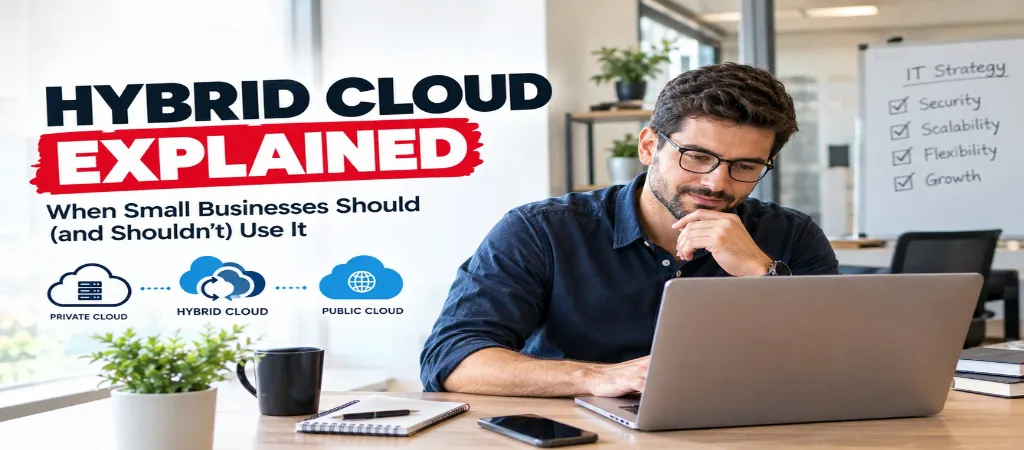
A hybrid cloud is an IT environment that incorporates a local/on-premise environment, as well as a third-party cloud service (e.g. Amazon Web Services, Microsoft Azure, Google Cloud), and makes them accessible to users as a single computing environment. From the users’ point of view, both environments should appear integrated and work together.
Hybrid Cloud vs Full Cloud vs On-Premise
Model
Description
Typical Fit
Fully on-premise
All servers and data physically on-site
Legacy setups, specific compliance/latency needs
Fully cloud
All infrastructure hosted by a cloud provider
Most modern SMBs, especially remote/distributed teams
Hybrid
Mix of on-premise and cloud, working together
Businesses with specific legacy systems, compliance needs, or gradual migration plans
When Hybrid Cloud Makes Sense for a Small Business
You have a legacy applicationthat can’t easily move to the cloud but still needs to integrate with newer, cloud-hosted tools
You’re migrating gradually, moving workloads to the cloud in phases rather than all at once, and need both environments to coexist during the transition
Compliance or data residency requirementsmean certain data must stay on local infrastructure, while less-sensitive systems can move to the cloud
You want cloud-based disaster recoveryas a backup to primary on-premise systems, without moving everything to the cloud immediately
When Hybrid Cloud Is Overkill
A business without an established way of doing things or any legal constraints that require on-premise facilities, typically has lower IT costs and less IT security risks if it uses only the cloud, instead of using a private and a public cloud (hybrid) system, and manages the interfaces between the two systems. Complexity increases in a hybrid system and justifies the case for a hyrid system if there is a clear need for it. Otherwise, using a hybrid system unnecessarily adds a number of IT systems that require management and increase IT security risks.
Common Hybrid Cloud Setups for SMBs
On-premise line-of-business software(common in some legal and accounting practice management systems) paired withcloud-hosted email and collaboration tools(Microsoft 365 or Google Workspace)
On-premise primary data storagewithcloud-based backup and disaster recoveryas a resilience layer
Gradual migration setups, where some departments have moved to the cloud while others remain on legacy on-premise systems during a phased transition
Security Considerations Specific to Hybrid Environments
There is a particular security trade-off for hybrid environments. With a hybrid environment, we must secure the connection between the on-premise and cloud environments. Often, the connection between the environments is not secure, and attacks can exploit this. In a pure on-premise or a pure cloud environment, these attacks would not be a concern. For a secure hybrid environment, we must implement MFA and security policies for both environments. Also, we must secure the connection between the environments.
Cost Reality: Hybrid Isn't Automatically Cheaper
Many assume a hybrid cloud strategy saves money by only moving “what needs to move” to the cloud. In reality, a hybrid cloud strategy almost always means you’ll have the costs associated with an on-premise data center in addition to the costs associated with a public cloud. There has to be a compelling reason, like the case for a gradual migration or compliance, for keeping data in both the on-premise data center and the public cloud. The hybrid cloud strategy should be used to address a specific situation, and it shouldn’t be assumed this is the least expensive option available.
How to Decide Which Model Fits Your Business
First, consider if you have any real-world constraints that require you to have on-premises infrastructure. For example, are there any compliance requirements or applications that can’t be easily moved to the cloud? If there are no real constraints, then usually acloud-only model is the easiest, most cost-effective option and is usually the most secure. If there are real constraints, then a case can be made to use a hybrid-cloud model only for that constraint. In general, a hybrid-cloud model should not be the preferred strategy.
How Ovron Inc Approaches Hybrid Cloud
Ovron Inc. takes into account a business’s particular constraints when making a recommendation regarding the type of infrastructure (hybrid or full cloud, or on-premise). We assess whether a legacy system would benefit from on-premise infrastructure, or if the system could be replaced by a new, modernized, system. We offer cloud migration and management services for both hybrid and full cloud environments. Security controls are applied uniformly to both environments.
Not inherently — hybrid environments introduce an additional security consideration at the connection point between on-premise and cloud systems, which requires its own careful configuration and monitoring. Neither model is automatically more secure; it depends on how well each is implemented.
Not typically. Maintaining both on-premise and cloud infrastructure usually costs more in total than committing fully to one model, unless there’s a specific requirement (legacy software, compliance, phased migration) that justifies the split.
A frequent example is on-premise legacy line-of-business software paired with cloud-hosted email, collaboration tools, and backup and disaster recovery — combining legacy constraints with modern cloud benefits where each is genuinely needed.
Generally no. Businesses without a specific legacy system or compliance requirement are usually better served starting with a fully cloud environment, which is simpler to manage and secure than a hybrid setup from day one.
Conclusion
Hybrid cloud is a legitimate solution to a specific problem — legacy software, compliance requirements, or a phased migration — not a default strategy that’s automatically better than full cloud or full on-premise infrastructure. The right starting question isn’t “should we go hybrid?” but “do we have a genuine constraint that requires it?”
Not sure which cloud model fits your business?Schedule a Consultationwith Ovron Inc for an honest assessment of hybrid, full cloud, or on-premise infrastructure.